
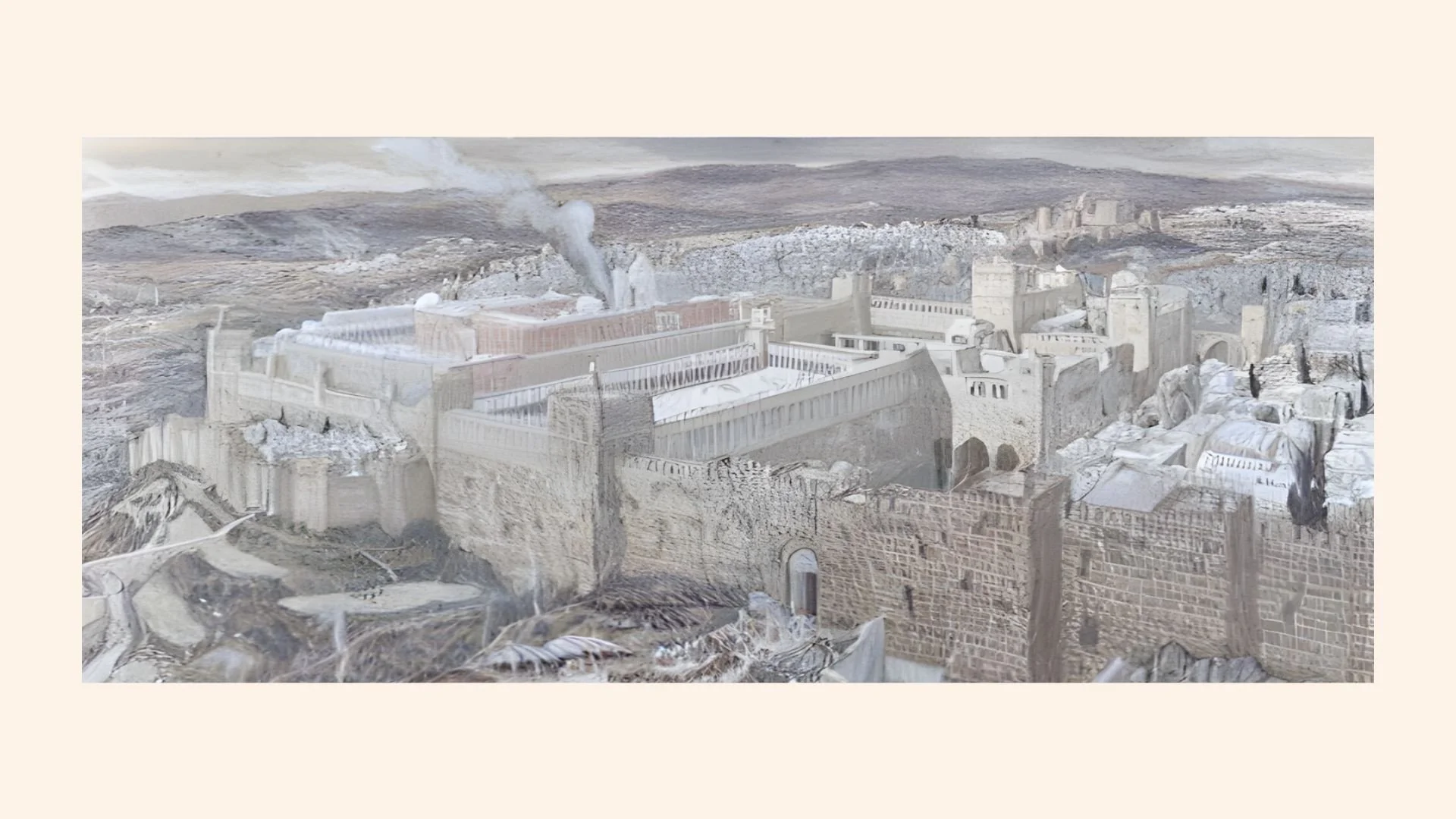
The City of God | Luke's Gospel chapters 19-24
towards Easter 2024
Many of us spend parts of our day agitated by questions. Who really are we at core and what should we actually be doing with ourselves? We are unsure of our identity, our activity. We hanker for a place and people where we feel safely at home to flourish freely, perhaps even playfully. We want to belong, to live meaningfully, so that our life genuinely matters to ourselves and to others whom we care about. Therefore, it distresses us when others misunderstand us. It disorientates us when we feel we don’t fit in, which gets exacerbated when believing everyone else is seemingly free to do their thing. So how exactly are we supposed to live well in this time and place?
Jesus didn’t ever seem derailed by these challenging questions. After ‘setting his face resolutely’ and repeatedly telling his friends where and why he is about to go, in Luke 19 we encounter Jesus finally coming into Jerusalem. Here and round about this city of David and temple of Herod Jesus will spend his last and greatest days. We watch him riding on a donkey, driving out marketeers, parrying trick questions, reclining at table, kneeling in prayer, standing before rulers and authorities, hanging on a cross, lying in a tomb, walking a desert road, breaking open bread and eyesight, showing hands and feet, being taken up into the heavens. In all of this, his actions seem so deliberate and self-assured. They are full of symbolism and intention.
Where did such confidence, such deep affirmation of knowing what was right, come from, making him so resilient, determined to stay the course?
As Jesus comes into Jerusalem, factions are jostling for power and influence under the rule of a hostile power in Israel’s promised land. God’s people are wondering who they now were and how God’s kingdom was to be experienced. What of their identity, activity, belonging, meaning, significance? Jesus answers these questions by saying ‘look to me’. That takes some boldness! What he points to is strange and unexpected, overturning many ingrained assumptions and shared values. How is his way truly God’s way?
In this series we enter Luke’s story at Jesus’ Triumphal Entry into his city, Jerusalem, following through to celebrate Easter and Ascension. Humbly, freshly, expectantly, we want to keep asking questions as we read this good-news story. How well do we understand Jesus and what he does? From what we see in him, what will we receive to answer our questions regarding how we are to live in ‘the city of God’ whilst dwelling in Sydney?
Life Group Discussion Starters
-
▶︎ Jesus in life (Luke 24) John Merchant
Discussion starters
Read Luke 24
What does it mean for us to exercise faith in Jesus dead and risen? Describe what it looks like and involves.
How does Jesus bring us peace in daily life through his resurrection?
How does Christ crucified and risen compel and shape us as peacemakers in this world?
-
▶︎ Jesus and the powerful (Luke 22:66 - 23:25) Miso Kim
Discussion starters
Read Luke 22:66-23:25
Are there times when our decisions are based on ambition or fear, rather than courage and conviction?
What can we learn from Jesus's response to the people who didn't believe Him?
How can you see justice being fulfilled through injustice in this passage?
What is our role as stewards of justice and agents of change?
Have you seen power misused in today's society? Share an example of power being used correctly.
Why didn’t Jesus use His power to put a stop to everything that was happening to him?
How did Jesus fulfill God's plan for us and what does that mean to you?
-
Discussion starters
Consider the three scenes: garden, valley and courtyard.
Garden - read Luke 22:39-46
C. Baxter Kruger says:
“As Luke tells us, Jesus Christ beat his way forward by blows. The Son of God entered into our broken, fallen, alienated human existence. He took upon himself our fallen flesh. He stood in Adam’s shoes… in our shoes, and he steadfastly refused to be “fallen” in it. Step by step, blow by blow… he refused to believe in the god of Adam and he loved his Father with all of his heart, soul, mind, and strength. Step by step, blow by blow… he hammered out his sonship on the anvil of fallen Adamic existence.” (C. Baxter Kruger, ‘Jesus and the undoing of Adam’)
How do you understand the difficulty that Jesus is experiencing in this garden?
Valley - read Luke 22:47-53 and Isaiah 53
How does the “meekness” of Jesus make you feel?
Can you recall an example of seeing someone powerful humble themselves to serve another?
Courtyard - read Luke 22:54-62
Have you experienced a failure from which you learned a great deal (or, perhaps, are now grateful for)? Would you be willing to share the outcomes of that?
Read Col 1:19-20 - what does this passage reveal to you about Jesus?
-
▶︎ Jesus defines and confers greatness (Luke 22:24-38) Steve Bernard
Luke 22:1-20 – Jesus defines and confers greatness
Discussion starters
Read Luke 22:1-6, 14, 19-38. What questions are raised as you read this text?
To what degree do you associate a person’s importance/greatness with their success?
In what ways is the idea of greatness defined by a person’s success or influence a distortion of true greatness?
Steve quoted the song ‘Phoenix’ by Big Red Machine which includes the lyric,
‘I was trying to find my way, I was thinking my mind was made, But you were making my heart change shape, It’s all that I could take.’
As you reflect on Jesus and his disciples at this meal, in what ways,
a. Are the disciples ‘thinking their minds were made’?
b. Is Jesus ‘making their hearts change shape’?“It’s not despite him being all powerful that Jesus lays down his life, but it is because he is all powerful that he is able to.” What implications does this have for how we should understand and approach a proper use of power?
In your experience with Jesus, in what ways is he / has he been making your heart change shape?
-
▶︎ Jesus's desire to eat (Luke 22:1-23) Steve Bernard
Discussion starters
Read Luke 22:1-20.
What does the Passover celebrate in the past?
In what ways does Jesus fulfil this event?
What does the Passover anticipate about the future?
In what ways does Jesus make this future hope secure?
What do you love about Jesus?
What does taking part in this meal mean to you?
-
▶︎ Jesus gives signs of destruction (Luke 21:5 - 38) Steve Bernard
Discussion starters
Read (some or all of) Luke 21:5-38. What questions does this text raise for you? (It is okay to voice these questions without needing to answer them straight away).
What is the significance and purpose of the Temple for the Jewish people?
How do you understand Jesus to be the Temple?
How should we understand the church as the Temple?
Read Luke 21:34-36. What instruction does this give us while we live in a time when it can seem that God has left us alone?
Watch this video on the theme of the Temple through the biblical story: Temple Biblical Theme (bibleproject.com)
-
▶︎ Jesus and his footstool (Luke 20:41 - 21:4) John Merchant
Discussion starters
Read Luke 20:41-21:4. What do you think Luke is doing for his readers in connecting the elements of this story in the way he does?
Considering 20:41-44
a. How do you answer Jesus’ question in v41?
b. What influence does this have upon your understanding of who he is, how he lives, and what it might look like to have him as lord?
Considering 20:45-47
a. Brainstorm examples from life today where people judge others positively or negatively based upon their appearance or behaviours.
b. Describe what a good leader ‘looks like’ in how they present themselves and interact with others.
c. Which people have influence in our society, and why are they given this power?
d. Who influences you and why (for both good and bad effect)?
Considering 21:1-4. What does this story say to you about your responses to poverty, money, and giving?
-
▶︎ Jesus and his children of the resurrection (Luke 20:27-40) Steve Bernard
Discussion starters
Download PDF
Read Luke 20:27-40. What questions are raised for you as you read this account?
What have you previously understood about what happens when we die?
Is anything you’ve heard in this message that is different to what you had previously understood?
What questions are raised for you as you consider Resurrection?
What can a follower of Jesus be confident about when we think about death?
Other resources:
-
▶︎ Jesus is questioned (Luke 20:1-16) John Merchant
Discussion starters
Read Luke 20:1-26. What actions, issues, and themes stand out to you?
In this passage Jesus claims authority to bring change as the one sent to realise God’s kingdom authority on earth now. Why are these ‘religious’, theological and social changes often so hard for us to embrace?
Describe in detail what it might mean for you to live under Jesus’ authority every day, and ‘give back’ what belongs to God.
What other authorities make claims on you, and how should these fit with God’s claim on you?
When and why are we tempted to resist Jesus’ authority over us?
How can we help one another through our friendships to not be like these leaders who resisted the authority of Jesus?
-
▶︎ Jesus enters his city (Luke 19:28-48) John Merchant
Discussion starters
Read Luke 19:28-48. What do you learn about Jesus from his actions here, and how might these shape your relationship with him now?
What caused the different people in the story (Pharisees, disciples, temple-sellers) to respond to Jesus in the particular ways they did?
Describe someone blind to what God is doing in our world and not responding positively to him.
If being spiritually ‘blind’ means you don’t see something that is true and real and so ignore or resist it, what experiences might help us realise (i.e. enlighten us) that we ourselves have this problem in one way or another in how we are presently living?
Describe someone making a positive response to Jesus as ruler present with us now.
Name one thing you want to do as a result of taking a ‘journey with Jesus’ in this story today.