
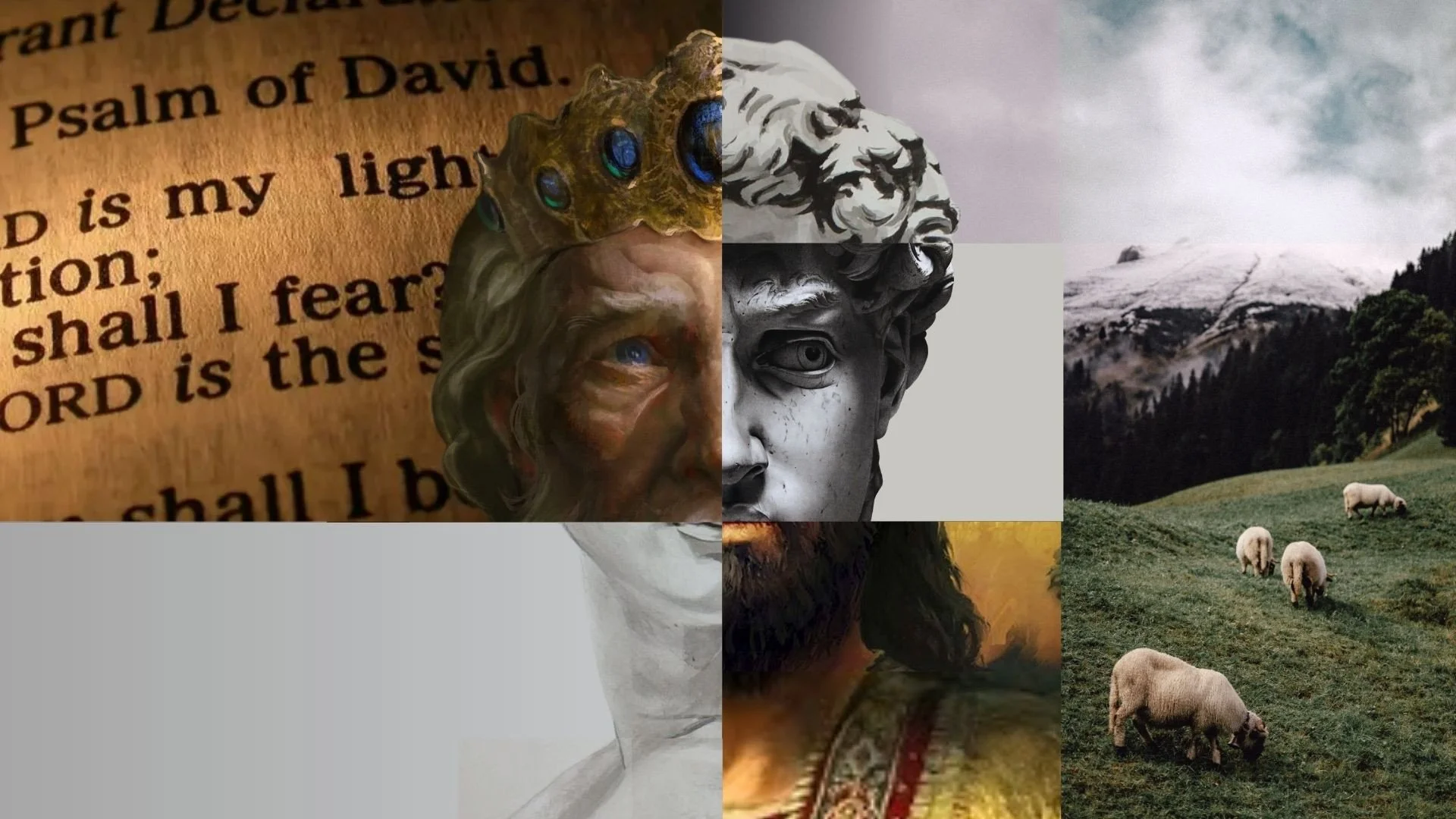
DAVID: earthy spirituality for Kingdom people
July-November 2023
‘We know more about David than any other person in Holy Scripture. As we tell and listen to the David story, we’re at the same time being trained in the nature of story itself as the primary literary form for receiving God’s revelation… Story is the gospel way. Story isn’t imposed on our lives; it invites us into its life. As we enter and imaginatively participate, we find ourselves in a more spacious, freer, and more coherent world… Story is the primary means we have for learning what the world is, and what it means to be a human being in it…
The David story, like most other Bible stories, presents us not with a polished ideal to which we aspire but with a rough-edged actuality in which we see humanity being formed – the God presence in the earth/human conditions... David deals with God. As an instance of humanity in himself, he isn’t much. He has little wisdom to pass on to us on how to live successfully. He was an unfortunate parent and unfaithful husband. From a purely historical point of view he was a barbaric chieftain with a talent for poetry. But David’s importance isn’t in his morality or his military prowess but in his experience of and witness to God…
The David story anticipates the Jesus story. The Jesus story presupposes the David story. David. Why David? There are several strands that make up the answer, but prominent among them is David’s earthiness. He’s so emphatically human: David fighting, praying, loving, sinning. David conditioned by the morals and assumptions of brutal Iron Age culture. David with his eight wives. David angry; David devious; David generous; David dancing. There’s nothing, absolutely nothing, that God can’t and doesn’t use to work his salvation and holiness into our lives. If we’re going to get the most out of the Jesus story, we’ll want first to soak our imaginations in the David story.’
Eugene Peterson, Leap Over a Wall
Life Group Discussion Starters
-
▶︎ Any last words? (2 Samuel 23:1-7) John Merchant
Discussion starters
Read 2 Samuel 23:1-7. What stands out here, and what questions does this passage raise for you?
What things do you think the writer is trying to achieve for the reader through having these ‘last words’ here after telling the story of David? Try and connect the themes of the various parts of the oracle to those following David, including us!
How are you passing on your experience of God to others?
What changes might you make so this could be more effective?
What lessons do you take from our study of David?
-
▶︎ David's theology (2 Samuel 22) Steve Bernard
Discussion starters
Consider the picture you have of David as we come to the end of this series.
a. Has that picture changed from how you previously viewed him?
b. Does your view of David now impact the way you view yourself? If so, how?Steve looked at three roles Israel's king was supposed to enact (in the outline of 2 Sam 21-24), which David fulfilled in part. How do you understand David both fulfilling, and failing to fulfil these three roles:
a. Mediator between God and people, making God accessible.
b. Leader of God's people, representing who God is.
c. Herald of God's kingdom, making God relatable.How do you understand Jesus fulfilling these roles?
What do you take from this series as a whole that helps you to come under the kingship of Jesus?
-
▶︎ Family dysfunction (2 Samuel 15) John Merchant
Discussion starters
Read 2 Samuel 12:10-12, then skim over 2 Samuel chapters 13-19.
a. How do you see God’s word to David being fulfilled?
b. What does this suggest to you about how God’s sovereignty and human responsibility work together in God’s providence?
Why are consequences important, even when we are forgiven?
How might we fool ourselves into thinking that doing nothing has no consequences?
Can you think of examples where people today don’t act to do good or help others, with negative consequences?
What should we do to help people who are being harmed by others, and what might tempt us not to act?
-
▶︎ Sinful sin (2 Samuel 11) Steve Bernard
Discussion starters
Read 2 Samuel 11-12. What stands out to you, or do you find surprising, in these chapters?
In what ways is David’s action a warning to us?
Why is desire "a good servant, but a bad master"?
How might you decide, in a particular situation, whether or not you should pursue what you want?
In what ways is David’s action a model for us?
What happens when we confess what we have done that is wrong?
-
▶︎ Can we be kind? (2 Samuel 9) John Merchant
Discussion starters
Please read 2 Samuel 9. What stands out to you in this passage?
What do you learn about kindness from the actions of David?
If discipleship includes the ‘five bees’ of belonging, behaving, believing, blessing, and becoming, how might these operate in your life as you grow in kindness?
Who needs kindness in your world at the moment?
What can you do to show kindness this week?
-
▶︎ God's sovereign grace (2 Samuel 7) Steve Bernard
Discussion starters
What do you think about the significance of having vision / dreams for shaping the future?
Read 2 Samuel 7 (esp vv.1-16). What do you understand to be God’s dream for David’s household?
What leads you to think Jesus may be the King that God is sending from the household of David?
Steve outlined four symptoms of chronic anxiety in a community and their alternative behaviours, as articulated by Edwin Friedman, being:
Reactivity > Self-regulation
Herding > Adaptation to strength
Blaming > Response to challenge
Quick-fix mentality > Allowing time for processes to mature
a. Which of these symptoms of chronic anxiety do you see as being present in our community?
b. How might we put the alternative behaviour into practice?
Do you have a dream for your family / our church that you could share with your group and pray about together?
-
▶︎ Out of the box religion (2 Samuel 6) John Merchant
Discussion starters
Please read 2 Samuel 6. What questions does this passage raise for you to consider?
How do you see fear, anger, and shame operating in this passage, and in what ways might they contribute to relationship breakdown for the people of God today?
In what ways can we try and control or protect God?
How might we express worship in public ways with freedom and joy?
When do Christians judge one another’s response to God, and what motivates them to do this?
-
▶︎ King and country (2 Samuel 5) John Merchant
Discussion starters
Please read 2 Samuel 5. What questions does this passage raise for you to consider?
This chapter concludes David’s difficult rise towards finally becoming king and gives a summary of what kingship will look like in his reign. Five key features are mentioned, which will be teased out in the stories of subsequent chapters in 2 Samuel. Look at these five areas and then consider: what did each mean at the time for David (and the writer); how does Jesus ‘fulfill’ yet transform each one as he brings the kingdom of God; and what temptations and opportunities do each bring for us as we live for the kingdom of God?
(i) verses 1-5: KINGSHIP: unity under leadership of a shepherd king
(ii) verses 6-10: CITY: Jerusalem the idealised dwelling place of God with his king
(iii) verses 11-12: PALACE: throne room from which to rule as king
(iv) verses 13-16: HOUSEHOLD: dynasty to perpetuate the covenant of kingship
(v) verses 17-12: COUNTRY: security and identity as a nation under the king
From this point on, David begins building the kingdom of God as a sanctuary for Israel. Jesus proclaims he is building the kingdom of God to include all nations and all creation. We are called by Jesus into his kingdom and to evidence his kingship of us as the household of God by offering the peace of sanctuary with God present with us. What changes in daily life having God as your sanctuary? How can we experience this as his family together? How can we welcome others into our community of sanctuary?
-
▶︎ Houses at war (2 Samuel 2) Steve Bernard
Discussion starters
Read some or all of 2 Samuel 2-4. What stands out to you in these stories?
In his book A Failure of Nerve, Edwin Friedman offers five major principles of leadership, being;
i. The capacity to separate oneself from surrounding emotional processes,
ii. The capacity to obtain clarity about one’s principles and vision,
iii. The willingness to be exposed and to be vulnerable,
iv. Persistence in the face of inertial resistance,
v. Self-regulation in the face of reactive sabotage.Where do you see these principles present
a. in David's leadership?
b. in Jesus' leadership?What differences do you see between David's leadership, and that of Jesus?
Friedman says,
“What makes these attributes universal is that they are not necessarily connected to personality traits, cultural factors, or anything that can be labelled gender-specific. They are rather qualities that have to do with the capacity to function well when the world about you is disoriented and stuck in a certain way of thinking. Nothing could be more universal. They apply equally to marriage, family life and work.”
Of these five leadership principles (at question 2. above), which do you find easier and harder to practice? What might it take to learn from one another in community how to lives these out?
-
▶︎ Good grief (2 Samuel 1) John Merchant
Discussion starters
Please read 2 Samuel 1. What feelings, thoughts, and questions are evoked by this passage?
How have you experienced or observed grief?
In what ways have losses impacted you? Have there been mixed feelings which has made this complex?
What cultural expectations and messages have shaped how you express (and talk about) emotion, particularly grief?
Why is lament an important life skill to learn, and how have you developed over your lifespan?
What can we do to help one another lament well?
-
▶︎ Share and share alike (1 Samuel 30) John Merchant
Discussion starters
Read 1 Samuel 30:1-6a and consider the pain of loss. What causes these men to behave as they do in blaming David for their loss, and what might they hope to achieve if they stone him? Can you think of times when you or others you know respond to pain in these ways, and what has resulted?
Read 1 Samuel 30:6-8. What does David do and not do in this situation in response, and what do you consider helpful in his approach?
Read 1 Samuel 30:9-17 and consider the pain of violence. If violence dehumanises both victor and victim, how might we respond in other ways, and what costs could this involve for us? Do you have experiences of trying such alternatives, and what wisdom have you gained?
Read 1 Samuel 30:18-30 and consider the pain of missing out. What thoughts and feelings operate in the ‘worthless’ men causing them to behave as they do? What makes it hard to share what we have with others? What things do people say to themselves to justify not sharing? What things might we say to ourselves to make it easier to share with others?
In verse 25 David makes sharing a ‘statute and rule’ for Israel. It is important to think about our personal sharing, but what about our society? How should sharing shape our economic systems, welfare provision, and political ambitions?
-
▶︎ My Enemy's Enemy (1 Samuel 27) - Steve Bernard
Discussion starters
Read (some or all of) 1 Samuel 26-27. What stands out to you in these two stories?
Karen Swallow Prior, says: “Temperance is not simply resisting temptation. It is more than merely restraint… One attains the virtue of temperance when one’s appetites have been shaped such that one’s very desires are in proper order and proportion.”
Similarly, Robert Roberts says, “Temperance is that state of character in which the bodily appetites successfully conform to the larger concerns of the moral life”.
Where in David’s character do you see is his desires;
a. out of order and proportion / unconformed to the larger concerns of the moral life?
b. in order and proportion / conformed to the larger concerns of the moral life?Read 2 Peter 1:3-11 thinking about temperance in your own life. What encouragement do you take from this passage?
In reflection on this passage and using NT Wright’s process for character formation, how might you practically grow in this? Is there work beyond this group time that you need to do?
NT Wright’s steps to character formation:
a. Aim at the right goal
b. Determine steps to reach the goal
c. Develop habits to make those steps second-natureFor personal reflection (or with a trusted friend): An exercise in self-understanding.
Karen Swallow Prior says: “Temperance is the virtue that helps us rise above our animal nature, making the image of God in us shine more brilliantly. For human, unlike animal, pleasure is tempered by understanding. Developing desires for the good requires understanding… The temperate person is one who ‘understands these connections between bodily pleasures and the larger human good, and whose understanding actually tempers the desires and pleasures’.”
Consider an area in your life where you may not be temperate, then write down your answers the following questions:
a. What is most important in your life? i.e. What is your view of the good life?
b. What role do you understand the appetite/desire you considered above playing in God’s picture of human flourishing? i.e. What are some God-intended expressions of this desire/appetite that lead to life and freedom?
c. What way(s) do you pursue/use this desire/appetite? Name all the ways you can, without judging them as ‘good’ or ‘bad’, by completing this sentence:
I pursue/use ______ as a way to ____________.
e.g. I use ________ as a way to relax after a stressful day.
e.g. I use _______ to help myself feel better when I am anxious.d. Compare what follows the ‘as’ (at c.), with your understanding of its wise usage (at b.) and what is important to you (at a.). Are there ways you currently use your appetite that is keeping you from the flourishing that God intends?
e. What help from others or further understanding do you need in order to determine steps and new habits for your character to be formed in this area?
-
▶︎ What Kind of Fool? (1 Samuel 25) - Steve Bernard
Discussion starters
Read 1 Samuel 25.
Can you share about a time when you felt angry because something was withheld from you, or you were wronged by someone?
Do you think the degree of David's anger is reasonable? How do you measure in your own responses (e.g. to situations at 2. above) what degree of anger is reasonable in a given situation?
Consider Abigail's actions and words to David. What in her approach do you think would help you when you feel wronged?
How do you understand Abigail’s actions as a reflection of what God does for us in Jesus?
Is there a particular relationship in your life where God might be asking you to learn to be more like Abigail? If you are able, share with the group about this then pray together asking for the help of the Spirit of Jesus.
-
▶︎ Choosing the Good (1 Samuel 23-24) - John Merchant
Discussion starters
Read 1 Samuel 23-24. What stands out to you in this passage?
The challenges and solitude of the wilderness are a place of formation for David (hence his many psalms composed through these times reflecting upon what is happening to him). We can experience a wilderness of place, but also of circumstances. What does wilderness do to us? How have you responded to such times?
How does fear operate through this narrative in the different characters and circumstances? How does fear cause you to behave?
Read 1 Samuel 23:16-18. How does Jonathan strengthen David, and how might we do similar things with one another?
Read 1 Samuel 24:17-19. How does Saul describe David and his actions? What does it mean for us to rise to the challenge of choosing to do good in the face of opposition?
This part of the story ends (in 24:16-22) with Saul expressing affection and making a covenant with David similar to that which Jonathan had made with David. Yet despite this apparent peace, the two part and soon hostilities resume. What does this show to us about forgiveness and reconciliation with others? How should these insights direct our practice of grace in our relationships?
-
▶︎ Fear and Paranoia (1 Samuel 21-22) - Steve Bernard
Conversation starters
Read 1 Samuel 21-22
How easily do you relate to the fear of David in running away? Is it foreign or familiar to you?
What have you found helpful to do when you have been afraid?
Consider the Psalms that relate to these events (Pss. 34, 52, 56, 57, 142).
a. What function do you think these Psalms played in David’s life?
b. What function does this kind of expression (whether our own songs / writings / or other creative expression, or using others’ as our own) have in your life?
How have your experiences of being afraid contributed to being a safe place for others when they are afraid?
Eugene Peterson says, “We enter the company of David not to improve our morals but to deepen our sense of human reality”. In what ways do these events in David’s life deepen your sense of our human reality?
-
▶︎ The loyalty of friendship [1 Samuel 20] - Pastor John Merchant
Discussion starters
Please read 1 Samuel 20. What questions does this passage raise for you to reflect upon?
Why do we need friendships to form us deeply and tease out our character and spirituality?
It seems (the generationally older) Jonathan intentionally developed friendship with David for a purpose consistent with Jonathan’s faith in God’s purposes for David. What steps can we take to build these types of deeper loyal friendships?
In verses 1-11 Jonathan communicates with integrity. What makes it harder or easier to be honest with our friends in our conversation?
In verses 12-17 Jonathan commits with faithfulness. What makes it harder or easier to think the best of our friends when wondering if we should give up on them?
In verses 41-42 Jonathan cares with affection. What makes it harder and easier to be comfortable with our friends in expressing physical affection?
-
▶︎ The Perils of Friendship (1 Sam 19) - John Merchant
Discussion starters
Read 1 Samuel 19. (You might like to read chapter 18 too). What questions does this text prompt you to ask?
Describe what it might have been like for Jonathan to speak up for David against his own father the king. How does he go about it?
Who might you find it hard to stand up against? Who can you think of in our world or amongst people you know personally who needs someone to advocate for them?
How can we advocate for others in ways which don’t disempower them or take away their voice in speaking up for themselves?
Michal takes considerable risks to protect David. What do you take from her actions?
What might it have been like for David to pour out his soul to Samuel, and for Samuel to hear these things? What is it like for us to hold friends in their distress by listening to them, and what approaches to this activity make it more or less helpful?
-
▶︎ Courage to Be (1 Sam 17) - Steve Bernard
Discussion starters
Take some time to the read the whole story from 1 Samuel 17:1-58
What different perspective did David bring to this situation that enabled him to be confident, when everyone else was afraid?
a. How might a perspective like this be cultivated in our own lives?
b. What have you found helpful when you have found yourself in a rut of fear, anxiety or dysfunction?
What can you discern from the text as some of David’s motivations for challenging Goliath? (Note the significance of the first words we hear him speak in v.26)
“It is the situations of great danger that David didn’t choose – where he had no choice but to face the lion or bear – that has prepared him for this moment that he does choose.”
Like David as a shepherd being prepared for this very moment, are there things in your life that you can see God using to train you for his purposes?
-
▶︎ Refreshing Tormented Spirits (1 Sam 16:14-23) - John Merchant
Discussion starters
Read 1 Samuel 16:13-23. Remembering how in chapters 13 & 15 of 1 Samuel we read of Saul’s repeated failures; and his blame-shifting; fear for his reputation rather than regard for what God instructs; and refusal to take responsibility for his actions even when acknowledging wrong-doing; what picture is the writer giving as the consequence of this behaviour in terms of God’s action and the impact upon Saul?
What does this story teach us about our practice of forgiveness?
Imagine you are king Saul, knowing that God will take your throne away from you because of your failures. Name as many feelings as you can to describe what he might have experienced. How do you think holding on to such feelings might impact behaviour?
Why can it be hard to accurately identify and understand negative emotions inside ourselves? What role might we take like that of the attendants. And how can we do this appropriately?
How can a broken relationship with God negatively impact our sense of self and our behaviour if we refuse to deal with it? Ultimately, how effective is David’s music therapy?
Consider the actions of Saul’s attendants and David. What is helpful and unhelpful in responding to someone else in their distress?
-
▶︎ Looking Inside Power (1 Sam 16:1-13) - John Merchant
Discussion starters
Read 1 Samuel 16:1-13. What issues can you identify in this time of transition of power in Israel.
Who has power in our world, and why do they have it?
What personal experiences of disillusionment or fear of those with power can you share?
Why does physical appearance give power to people? How can this be harmful to others and themselves?
How do you use your power, and how do you justify this?
What is your understanding of a Christian use of power, and how political power and religion should interact?